
Autonomous farming has moved from concept to commercial reality say industry leaders
Agricultural automation has reached a tipping point, with autonomous systems now delivering measurable benefits on commercial farms and moving beyond the experimental stage, according to speakers and industry experts at the Institution of Agricultural Engineers’ (IAgrE) 2026 Landwards Conference.
Held at Harper Adams University, the conference, Automation in Agriculture: From Innovation to Impact, brought together engineers, researchers, technology developers and farmers to examine how autonomous technologies are being adopted across the agricultural sector.
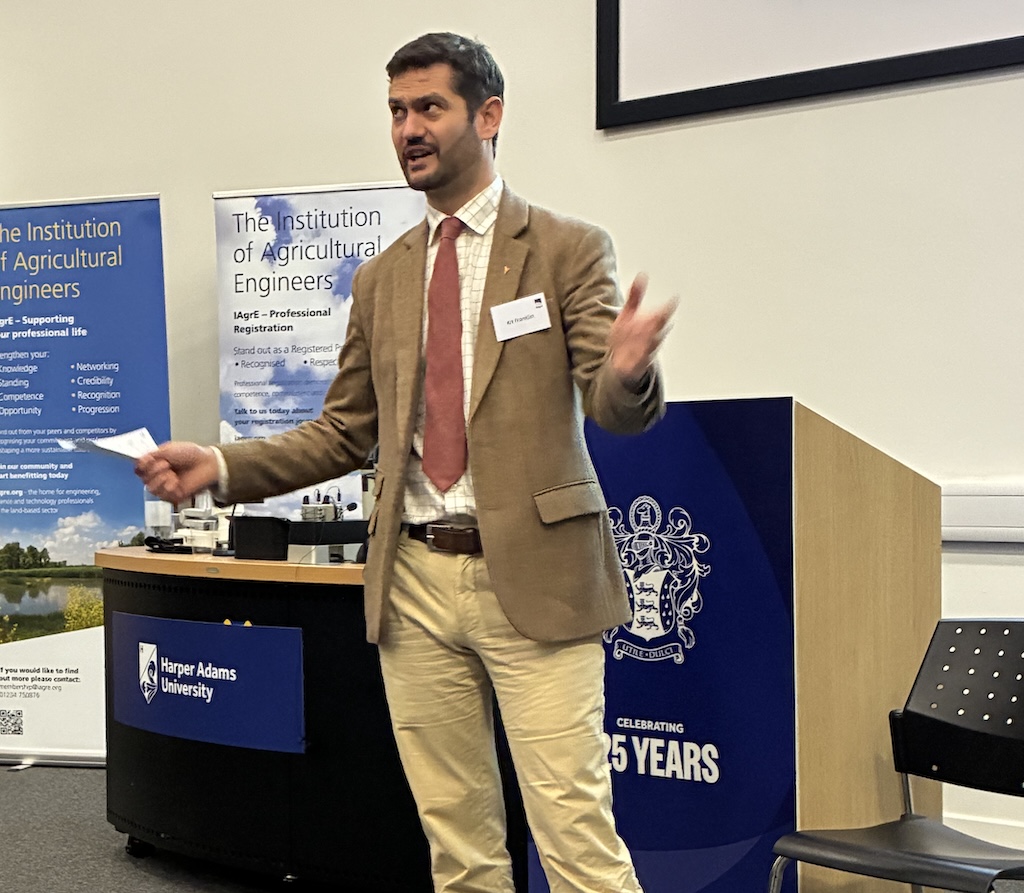
Opening the conference, IAgrE President Kit Franklin said the agricultural engineering sector has moved beyond asking whether autonomous systems can work.
“The conversation has changed dramatically over the last decade,” he said. “Today, the challenge is no longer proving autonomous systems are technically possible. The focus is now on demonstrating reliability, commercial value and real-world results for farmers.”
The conference heard examples of autonomous and AI-enabled technologies already delivering practical benefits in commercial farming businesses.
Dermot Tobin of PDM Produce UK reported significant reductions in labour requirements through the adoption of laser-weeding technology, while William Mumford, Chief Executive of AS Communications and an AgXeed distributor, highlighted how autonomous machinery is helping to reduce fuel consumption and minimise soil impact.
Delegates also heard how artificial intelligence and machine vision are enabling precision weed control systems capable of reducing reliance on conventional crop protection methods, whilst researchers continue to develop robotic solutions for labour-intensive tasks such as harvesting and crop handling.
A recurring theme throughout the conference was that future adoption will depend not only on technological innovation, but on delivering systems that are commercially viable, trusted by farmers and supported by the skills required to operate and maintain them.
Addressing one of the most significant questions facing the industry, panellists discussed whether automation could help secure the future of smaller farming businesses.
Examples presented during the event suggested that autonomous technologies may offer particular advantages to family farms by addressing labour shortages, improving operational flexibility and enabling farmers to continue working land that might otherwise become uneconomic.
Cybersecurity and resilience were also highlighted as growing considerations as farming becomes increasingly connected and data-driven. Experts stressed the importance of incorporating safety and security into autonomous systems from the earliest stages of development.
The conference concluded with a forward-looking discussion on the future of agricultural engineering. Speakers agreed that the next generation of agricultural engineers will require a blend of traditional engineering expertise, digital skills, data analysis and robotics knowledge as automation becomes increasingly integrated into modern farming.
Reflecting on the progress made within the sector, Kit Franklin noted that predictions made a decade ago have largely become reality.
“Ten years ago, I was regularly asked when autonomous farming would become normal,” he said. “My response was that by the middle of the 2020s it would be unsurprising to see autonomous agricultural systems operating on farms. Looking at the examples shared at this conference, that point has now been reached.”
He added: “The important challenge now is ensuring these technologies continue to deliver genuine value to farmers whilst helping the industry increase productivity, improve sustainability and attract the skilled people needed for the future.”
The conference formed part of IAgrE’s continuing commitment to supporting knowledge exchange and innovation across the agricultural engineering profession.
Related news:
Caterpillar acquires Monarch Tractor assets to boost autonomous technology push


