
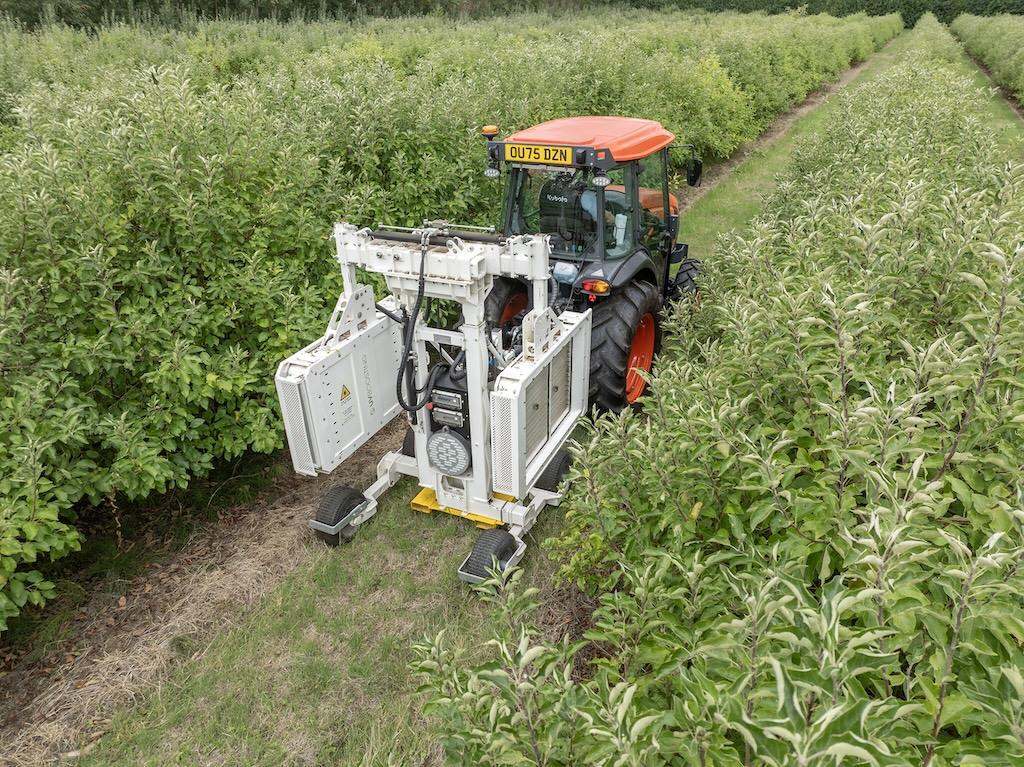
UV-C technology targets crop resilience in orchard applications
Kubota (UK) is adding UV-C crop stimulation technology to its Smart Farming Solutions portfolio, with the introduction of the Helios Orchard system at LAMMA 2027.
Developed through a partnership between Kubota Corporation and French technology start-up UV Boosting, the system uses controlled flashes of ultraviolet-C light to stimulate plant defence mechanisms, potentially helping growers reduce their reliance on fungicides and improve crop resilience.
UV-C is short-wave, high-energy radiation that is naturally filtered out by the Earth’s ozone layer. Rather than using it directly to destroy fungal pathogens, the technology aims to trigger a physiological response within the plant, strengthening its natural defence mechanisms against disease and environmental stresses.
These include fungal infections as well as abiotic stresses such as spring frost and drought. The treatment can be applied through multiple passes and is designed to operate irrespective of prevailing weather or natural light conditions.
The Helios Orchard configuration has been developed specifically for fruit production, using two vertically mounted light panels to deliver UV-C flashes to growing trees. Electrical power for the panels is generated on-board, with the system driven through the tractor power take-off (PTO).
The technology offers an alternative approach to crop protection, seeking to complement existing disease-management strategies through plant stimulation rather than direct chemical intervention.
The Helios Orchard will be on stand as part of Kubota (UK)’s Smart Farming Solutions offering at LAMMA 2027, taking place at the NEC, Birmingham, on 20–21 January.
Related news:


